Introduction
The question to most people is; is autism an intellectual disability? when such individuals become aware of delays in communication, learning or social behaviour. Autism and intellectual disability may seem to be similar, however, they are not comparable. Autism is a neurodevelopmental disorder which impacts on the ability to communicate socially and the behaviour, whereas the intellectual disability impairs the ability to think as well as to perform generally.
Consequently, in seeking to understand the answer to the question, is autism an intellectual disability, it is important that we cut the differences, know where the two conditions intersect, and how each of them impacts on our lives.
What Is Autism?
Before responding to the question, is autism an intellectual disability, it would be appropriate to define autism. Autism Spectrum Disorder (ASD) is a disease that impairs:

- social communication
- sensory processing
- patterns of behaviour recurring in the same way.
- emotional regulation
But the autism does not necessarily influence the intelligence. People with autism can have:
- average intelligence
- above-average intelligence
- gifted-level intelligence
- or intellectual disability
Since autism is a condition that affects behaviour and communication as opposed to global cognitive ability, it is distinct to intellectual disability.
What is Intellectual Disability?
To have a clear understanding of autism as an intellectual disability, intellectual disability must be defined. Intellectual disability (ID) entails:

- severe intellectual retardation (IQ normally less than 70)
- adaptive skill (daily living, communication, problem solving) problems.
- symptoms in people younger than 18 years of age.
Intellectual disability does not impact on social or behavioural skills only, but on the general learning ability.
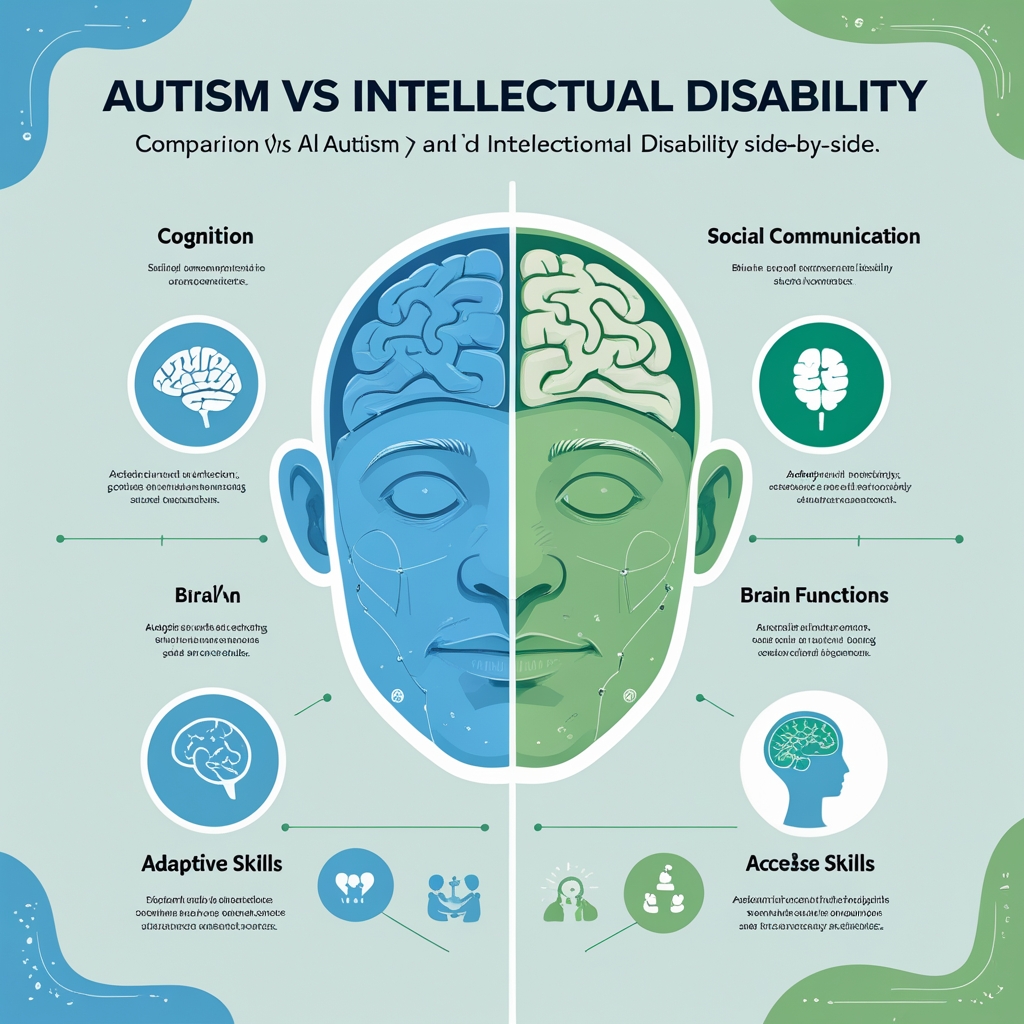
Autism vs Intellectual Disability

| Feature | Autism Spectrum Disorder | Intellectual Disability |
| Core Issue | Social communication & behaviour | Global cognitive ability |
| Intelligence | Can be low, normal, or high | Usually below average |
| Adaptive Skills | May vary widely | Significantly impaired |
| Cause | Neurodevelopmental | Cognitive developmental |
| Diagnosis Method | Behaviour-based | IQ + adaptive functioning tests |
| Can They Co-occur? | Yes | Yes |
This comparison helps clarify the confusion around is autism an intellectual disability.
Can Autism and Intellectual Disability Co-Occur?
Yes, they can. Indeed, there are numerous cases of children and adults possessing the conditions. When individuals pose the question of whether autism is an intellectual disability or not, the misunderstanding is brought about by similarities like:
- delayed language
- problem in acquiring new skills.
- problems in autonomy.
Nevertheless, the average or high intelligence of a person can make him or her autistic and this means that autism is not an intellectual disability by itself.
Prevalence of Intellectual Disability in Autism?
Research indicates that approximately 3040 percent of autistic people are also intellectually disabled. Therefore, although autism is not inseparable with ID, there are numerous individuals who have the two.
This overlap highlights why a careful observation should be done when ascertaining whether autism is an intellectual disability.
Symptoms Autism Presence in the absence of intellectual disability.
In case an individual has normal/high intelligence despite being autistic, he/she may exhibit:
- advanced vocabulary
- strong memory
- strong passion in certain things.
- excellent logical thinking
- capability of acquiring knowledge fast in orderly conditions.
Yet they still struggle with:
- social cues
- eye contact
- sensory issues
- transitions
This differentiation once again provides answers to this question: is autism an intellectual disability?
No – since cognitive ability can not be reduced altogether.
Autism Symptoms With Intellectual Disability.
In case of autism and ID, people can experience:

- crucial delays to learning.
- reading, writing or math difficulty.
- difficulties in the activities of daily living.
- minimal speech
- weaker problem-solving abilities.
Such difficulties are not associated with autism, but intellectual disability.
Why the Distinction Matters
It is important that we understand autism as an intellectual disability since it is only through proper diagnosis that the treatment would be effective.
Autism Support Focuses On:
- communication skills
- social behaviour
- sensory processing
- emotional regulation
Intellectual Disability Support concentration is on: - academic learning
- daily living skills
- independence
- problem-solving
Therapy is more holistic when the two are used simultaneously.
Diagnosis: The Professionals and the Difference in Telling.
The separate tests are used by professionals to establish whether autism is an intellectual disability or both conditions co-exist.
- Autism Assessment
- ADOS
- ADI-R
- Behavioural observation
- Sensory evaluation
- Special Education Assessment: Intellectual Disability.
- IQ test
- Adaptive behaviour test (Vineland)
- Cognitive functioning test.
Autism and intellectual disability can only be diagnosed when the two categories depict deficiencies.
Final Solution: Autism Intelligence Disability?
The last response to the question of whether autism is an intellectual disability is in the negative. Autism is a neurological disorder whereas intellectual disability is a cognitive disorder. They are intersecting but intellectual disability is not necessarily a part of autism.
FAQs
1. Is autism an intellectual disability?
No. Autism affects communication and behaviour, while intellectual disability affects cognitive functioning.
2. Can autism occur without intellectual disability?
Yes. Many autistic people have average or high intelligence.
3. How do you know if autism includes intellectual disability?
Professionals assess IQ, adaptive skills, and behaviour. Only low scores in both areas suggest ID.
4. Do autistic children learn slower?
Not always. Some learn quickly but differently, especially when using visual or structured methods.
5. Can adults with autism and no intellectual disability live independently?
Yes. Many live independently, study, work, and build successful careers.